

My role
Senior Product Designer
Project type
Greenfield product, new concept
Duration
Team
Industry
There was no engaging, credible place online for a casual player to properly learn blackjack. We had the expert, the budget and the opportunity to build it.
Overview
The Blackjack Academy was a standalone learning platform built under the onlinegambling.com umbrella, designed to teach players how to play blackjack through a series of short, professionally produced videos. The idea came from a genuine gap in the market. There were a handful of blackjack courses online, but nothing coherent, complete or engaging enough to serve a casual player who simply wanted to learn the game properly. iTech Media had already brought on board Matt, a professional Canadian blackjack player and ambassador known as Mr Blackjack, as part of the main onlinegambling.com offering. The Blackjack Academy was the natural next step: a dedicated platform built around his expertise and on-screen presence, with 72 videos organised across 8 seasons, covering everything from the absolute basics through to advanced strategy and card counting.
My role was to conceive and design the platform experience from the ground up. Where would users land? How would they navigate 72 videos without feeling overwhelmed? How do you make a learning platform feel engaging rather than dry? Those were the questions I was designing to answer. I also took it upon myself to create a logo for the platform, one that would visually complement the existing onlinegambling.com brand while feeling distinct and purposeful in its own right.
My Approach
This project came with an unusual constraint: despite significant investment going into the video production itself, including flying Matt over from Canada to London for the shoot, no research budget was allocated for the design process. It was a decision I pushed back on at the time, and one I still think was a missed opportunity. That said, I worked with what I had. I ran informal guerrilla testing sessions internally, putting early prototypes in front of selected colleagues to assess usability, gather reactions and identify friction points before anything was built.
From there I worked through user flows and blockframes to establish content hierarchy and information architecture before moving into lo-fi wireframes and then hi-fi designs. The focus throughout was on making the content feel structured and easy to navigate without it feeling like homework. The 8 season structure gave us a natural framework to work with, and the design leaned into that, giving users a clear sense of where they were in their learning journey and what came next.
Key Design Decisions
With 72 videos across 8 seasons, navigation was everything. The course plan became the backbone of the experience, a page that served as the user's map through the content, and the data later confirmed this was exactly how people were using it. Returning visitors headed straight there, using it as a launchpad to pick up where they had left off.
The logo was another considered piece of work. It needed to sit comfortably alongside the onlinegambling.com visual identity while standing on its own as a recognisable brand. The mark I developed was designed with scalability in mind from the start. The same icon could carry across future academy products, The Poker Academy, The Roulette Academy and beyond, simply by swapping the background colour and theming. That kind of thinking meant the brand could grow without starting from scratch each time. I also produced an animated version of the logo in Ae, which gave the marketing team a polished asset that elevated the overall feel of the product at launch.
The platform launched with video content only, but the roadmap was already taking shape. Quizzes, a test your knowledge feature, gamification elements and an interactive blackjack table for engagement were all planned as future iterations. The early data gave us a strong foundation to build from.
72
videos across 8 seasons, live at launch
3X
more content consumed per visit compared to the rest of the site
267
keywords ranking within the first month of going live
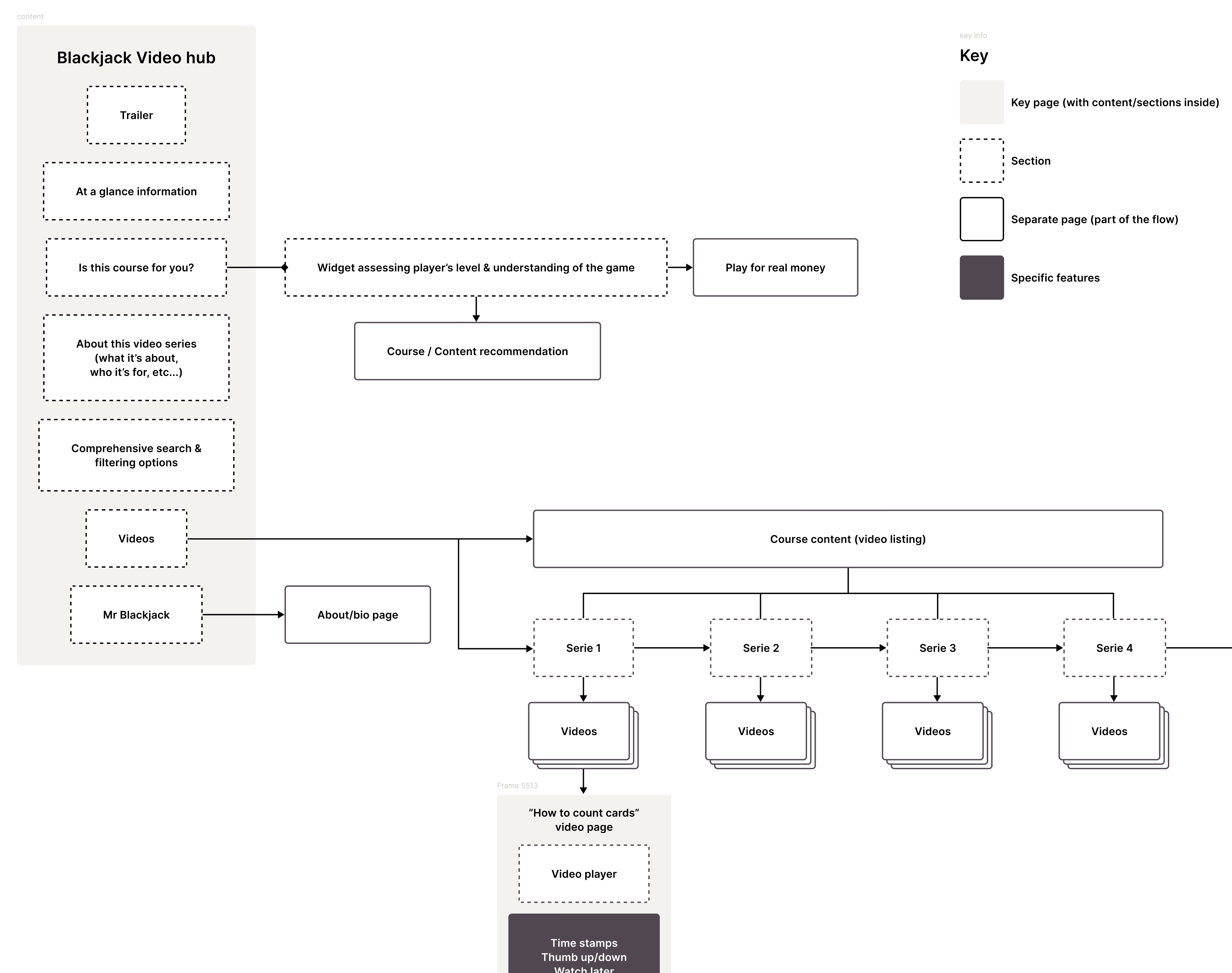
Flow diagram / simple sitemap: Mapping the structure of the platform before a single screen was designed. This diagram established the key pages, content sections and user pathways, including how the knowledge assessment widget would route users to personalised content recommendations.
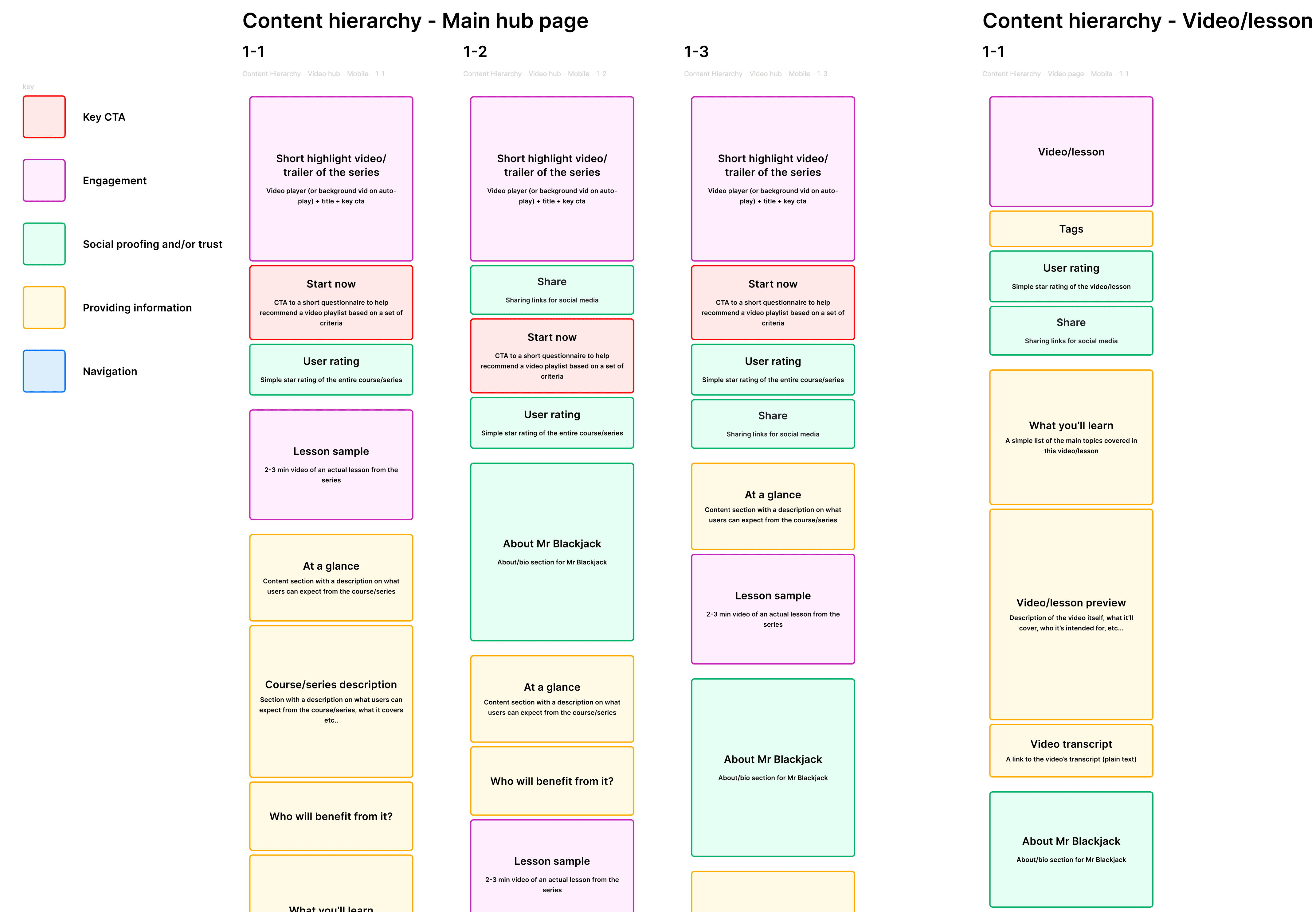
Blockframes: Colour coded content hierarchy frames exploring how different page types should be structured on mobile. Each block represents a content category, engagement, navigation, trust signals, CTAs allowing us to test information architecture and content priority before committing to visual design.
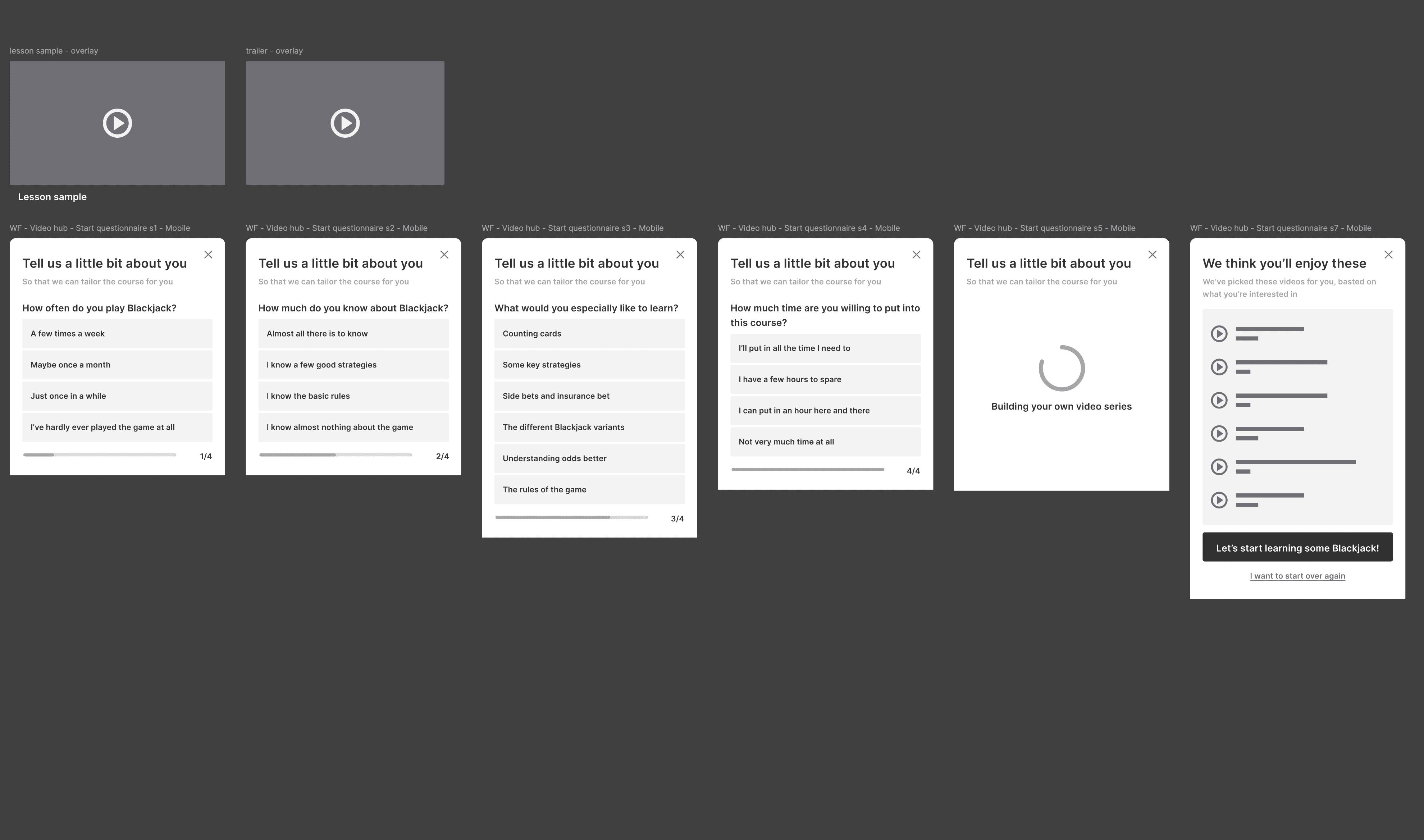
Mobile wireframe: Personalised course builder A future concept for personalising the learning experience from the start. A short questionnaire assessing a user's existing knowledge, learning goals and time availability would generate a tailored video playlist, removing the need to navigate 72 lessons from scratch.
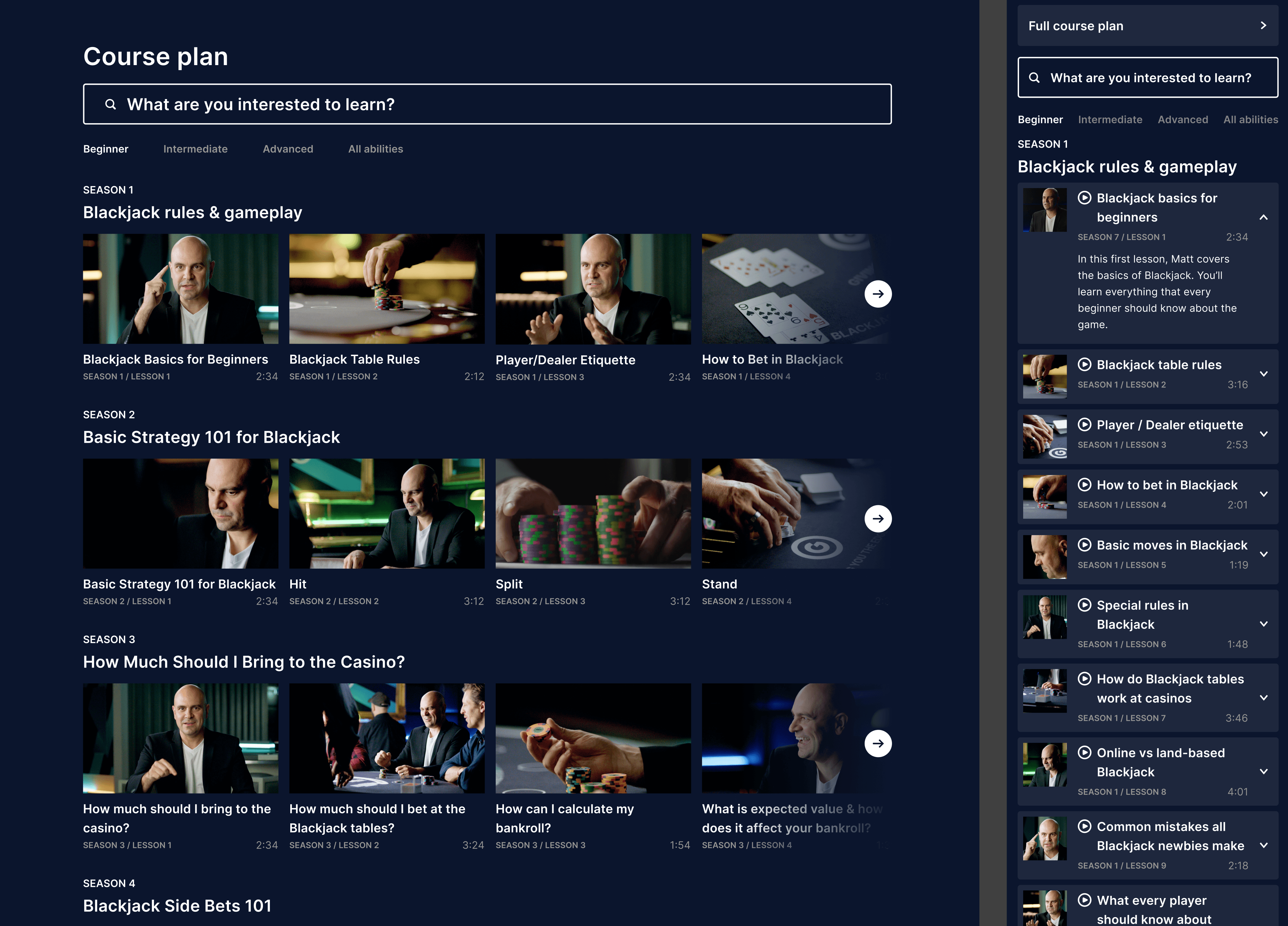
Desktop and mobile hi-fi course plan The course plan was the backbone of the platform, giving users a clear map through all 8 seasons and 72 lessons. Data confirmed this after launch: returning visitors navigated directly to this page, using it as their primary entry point back into the content.
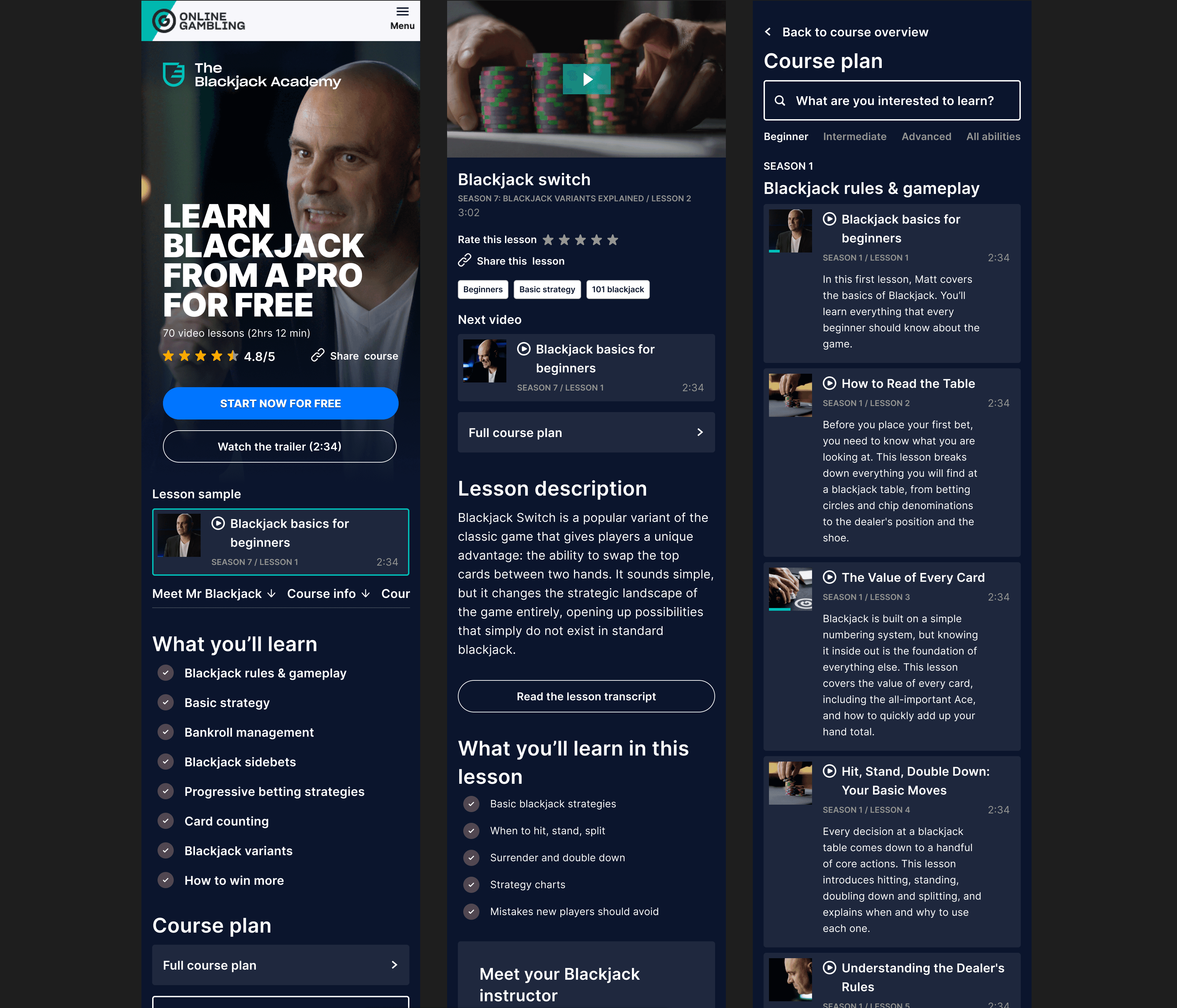
Mobile hi-fi homepage, lesson page and course plan Three core screens of the mobile experience. Designed to make a content-heavy platform feel approachable and easy to navigate on a small screen, with clear hierarchy, persistent course navigation and a lesson page structure built around the video itself.

The Blackjack Academy logo A shield mark combined with ascending steps, the shield nodding to the credibility and tradition of academic institutions, the steps representing progression and levelling up through the course. Designed to complement the onlinegambling.com brand family while giving The Blackjack Academy a distinct identity of its own.

Brand system: Future academy extensions The same mark applied to The Poker Academy and The Roulette Academy, demonstrating how the identity was designed as a scalable system from the start. Each extension retains the core icon while using colour and texture to create a distinct visual world for each game.
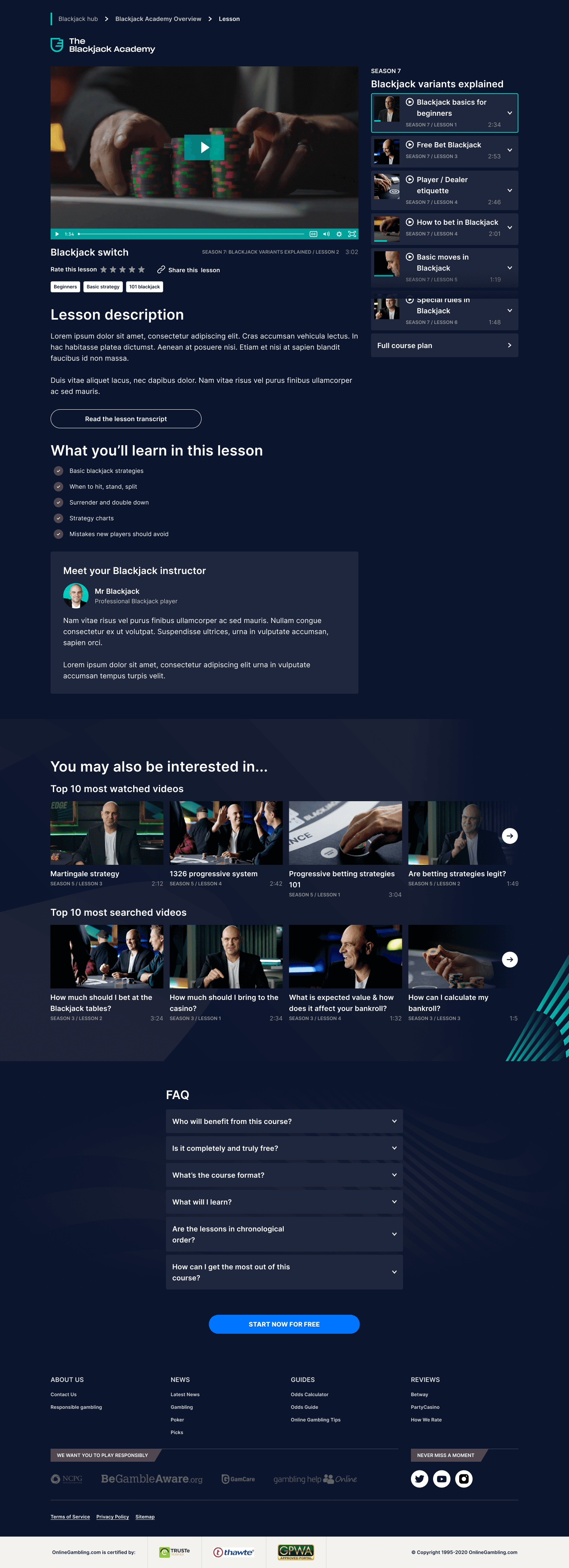
Desktop hi-fi lesson page The full lesson page experience on desktop, with the video player, lesson description, learning outcomes and in-season navigation all visible in a single view. Designed to keep users in the content and make onward journeys to the next lesson as frictionless as possible.
Reflection
The Blackjack Academy launched, performed well and ran for several years, which is more than can be said for a lot of digital products. The early analytics were encouraging: users were consuming significantly more content than on any other part of the site, returning visitors were bouncing at a much lower rate, and the platform was ranking for keywords within weeks of going live. Mobile users in particular were engaging more deeply than desktop, a sign that the experience was working across both contexts.
That said, the absence of a proper research phase left some gaps. The data flagged that users were skipping trailers and end-of-video links, which reduced onward journeys to related content. Game variant pages saw low engagement, suggesting a mismatch between what we assumed users wanted and what they were actually coming for. These were solvable problems, but by the time the data was in front of us, I had already moved on to another product and team. The iteration that the platform deserved never quite happened.
The decision to skip research despite the scale of investment elsewhere in the project is something I think about. A modest amount of upfront user insight would have cost a fraction of the video production budget and almost certainly improved the experience at launch. It is a reminder that advocating for research is part of the job, even when, and especially when, the pressure is to move fast.
Get Figma Version